










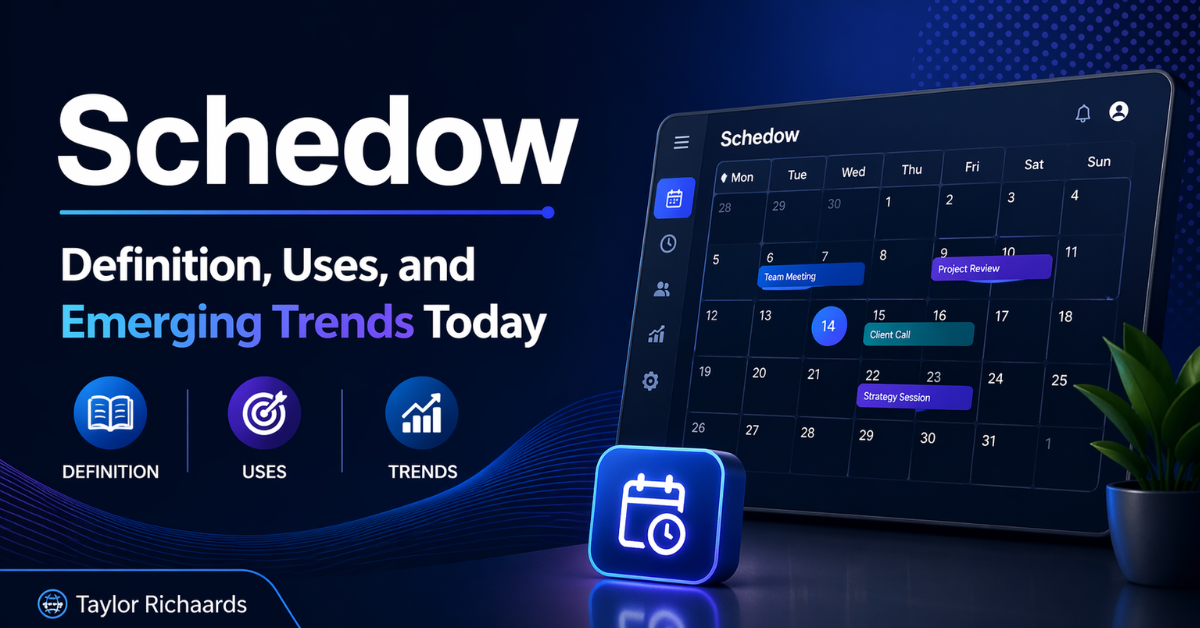
Introduction to Schedow Guide
As new technologies and approaches emerge in the digital realm, they alter the way we accomplish our jobs. The Schedow Guide is one such invention; it is a notion that is gaining popularity in many different fields. However, kindly explain what this comprises. Anyone interested in process optimisation and productivity gains may benefit from learning about Schedow, whether they are company leaders, IT enthusiasts, or just plain curious about developing trends. Countless sectors are about to undergo a paradigm shift, and we invite you to explore this interesting tour with us.
What is Schedow Guide?
Schedow Guide is a cutting-edge program that simplifies a lot of different tasks. Fundamentally, it serves as an all-inclusive road map for businesses that want to boost productivity.
Various industry-specific frameworks, best practices, and approaches are covered in this handbook. In order to meet their own operating requirements, users can simply modify these rules.
It can be utilised in various domains due to its adaptability, including healthcare, logistics, and project management. It simplifies complicated work for teams by providing straightforward directions.
It also stresses the need of teamwork and open dialogue. By encouraging a cohesive strategy, it guarantees that all individuals are working towards shared objectives.
Guide’s continued applicability is directly proportional to the rate at which companies adapt to the digital era. Its malleability helps businesses respond quickly to shifts in the market and maintain a competitive edge.
The Evolution of Schedow Guide
There have been several changes to the Schedow Guide since it first came out. At first, it was only a simple framework for organising when things needed to be done. A more advanced tool that merges technology with managerial procedures, it evolved over time.
Schedow Guide used automation and real-time data tracking in response to the growth of digital platforms. With this change, users may dynamically adjust their timetables according to the needs of their projects or the resources at their disposal.
In addition, working together became an important part of its development. Now that teams may now alter their schedules and share ideas jointly, productivity is enhanced overall.
Its expansion was further accelerated by its ability to integrate with other software products. By integrating their preferred applications, users may streamline their processes, which in turn saves time and cuts down on mistakes.
In response to the ever-increasing rate of change in many sectors, the Schedow Guide is always evolving to address emerging needs while upholding time management best practices.
How Schedow Guide is Used in Different Industries
Schedow is quickly becoming an indispensable tool in many different fields. In the field of education, it simplifies the process of class and test scheduling, which helps to distribute resources more efficiently. This improves the educational process by reducing disagreements.
It is a tool that helps healthcare providers organise patient appointments. Reduced wait times and improved patient flow are the results of optimising doctor and specialist schedules.
It is also very useful to the business sector. Meetings and project schedules are both improved with the help of this guidance. So what happened? Productivity boosted and teamwork improved.
It has also been welcomed by event planning. Whether it’s a wedding or a conference, planners may draw out comprehensive schedules to make sure everything runs well.
To avoid needlessly stocking up on items during sales events or holidays, retailers also use Schedow for inventory management.
Advantages and Disadvantages of Schedow Guide
There are several benefits to using the Schedow Guide. It simplifies complicated operations by providing an organised approach that improves clarity. Teams’ output can be greatly enhanced in this way.
On top of that, it encourages uniformity in procedures. Making sure everyone is using the same handbook helps cut down on mistakes.
On the other hand, there are downsides. In certain cases, being too literal with the guidance could limit your capacity to think on your feet and make adjustments. Teams may have limitations due to predetermined procedures.
There is a learning curve and some adjusting involved in using the Schedow Guide. In order to successfully reap long-term rewards, organisations need to spend resources up front.
Organisations contemplating its implementation must carefully weigh these advantages and disadvantages.
Emerging Trends in the Use of Schedow Guide
Schedow is changing its landscape at a quick pace. Artificial intelligence (AI) powered scheduling solutions are gaining popularity among businesses. Efficient resource optimisation is made possible through this integration, leading to improved decision-making.
Organisations’ utilisation of Schedow has also changed due to remote work. The need for collaborative capabilities and real-time information has skyrocketed due to teams’ dispersed locations. Modern tools can now work with schedules that are more adaptable to different time zones.
Prioritising interfaces that are easy for users to navigate is another new trend. Users are more engaged and can easily traverse complex schedules when the design is simple.
Companies’ use of Schedow is also being impacted by sustainability objectives. Companies are on the lookout for ways to optimise resource allocation and cut down on carbon emissions while simultaneously streamlining processes.
Schedow systems’ future tendencies are heavily influenced by data analytics. If you want better predictions and more strategic planning choices, you need to analyse patterns.
Conclusion
In order to improve planning and management, the Schedow Guide has become an indispensable tool in many different businesses. This guide will remain relevant as long as we are investigating new technology and methods. As more and more companies use data-driven initiatives, its flexibility becomes more apparent.
Schedow is being used more and more by businesses to automate processes, increase efficiency, and better manage workflows, according to emerging trends. Expertise with Schedow is anticipated to be in high demand as its potential is recognised by additional industry.
Given these considerations, it is evident that the Schedow Guide is an essential tool for anyone aiming to succeed in the modern, fast-paced world. Utilising the potential of this book may result in substantial improvements to productivity and success rates, regardless of your organization’s size.
Read More: Dojen Moe Explained: Meaning, Trends, and Key Insights Today